THRESHOLD
A practice of one can be a brand. A practice of eight is a problem.
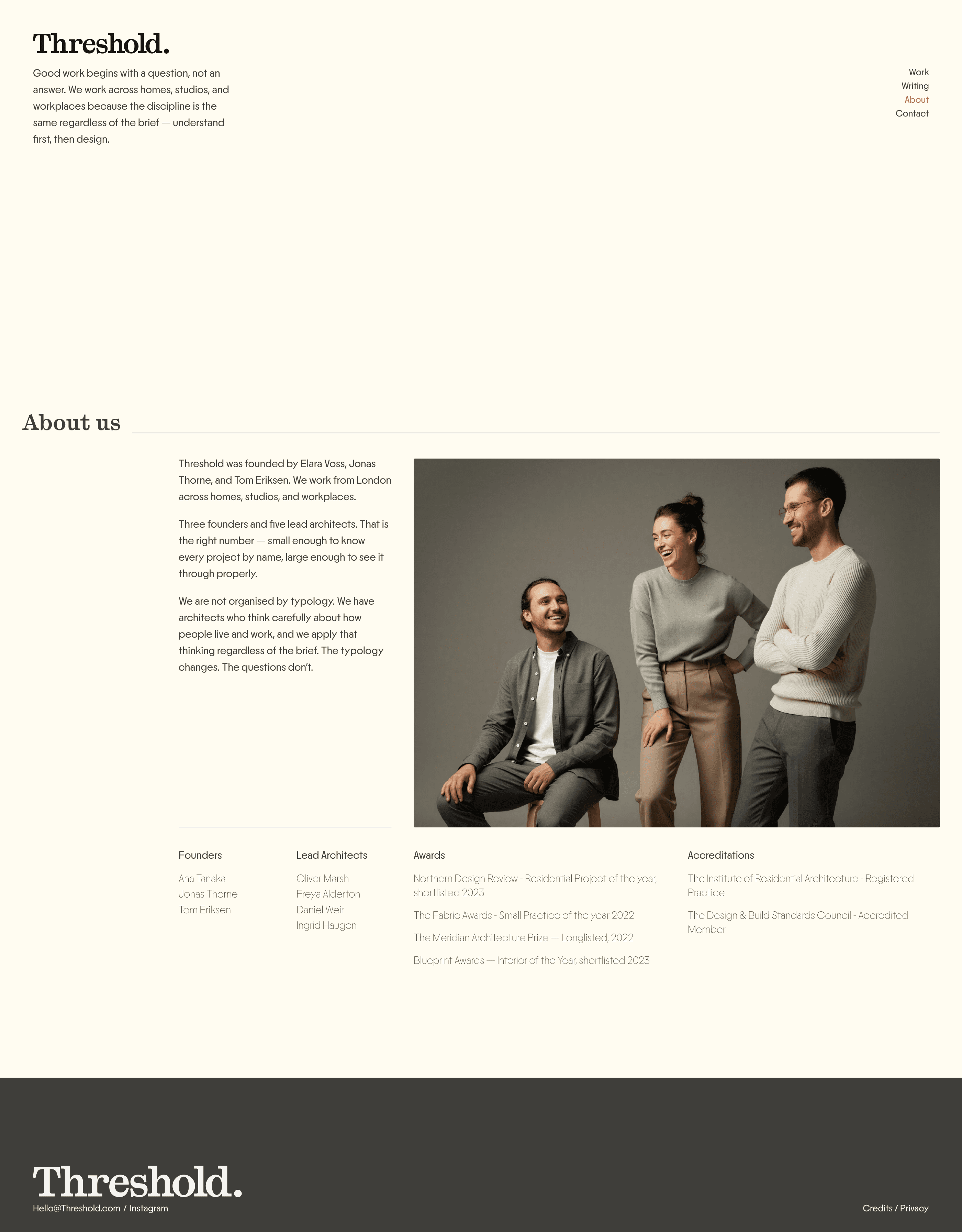
Threshold has three founders and five lead architects. Any of them might run a given project, which means the practice cannot sell a person. It has to sell the thing all eight have in common — and the whole site exists to find that thing and hold it up.
It is the question. Not the buildings, which vary; not the founders, who divide the work; not a house style, which would be the wrong answer. What every architect here shares is the habit of refusing the brief as given and restating it more precisely. A bookstore is not a shop. A studio is not measured in square feet. The site opens every project that way because that opening is the practice — the one gesture that survives no matter whose name is on the drawings.
Most studios this size brand themselves one of two ways: they lean on a founder's name, or they sand everything down to a neutral house style. Both treat consistency as something applied to the surface. Threshold's consistency is in the method — the only thing that can honestly hold eight people together, because it's the only thing all eight actually do.
So the site doesn't describe Threshold. It performs the practice's single move, on every page, until a reader stops seeing eight architects and starts seeing one mind. Whether they could name what unifies the work is beside the point. They feel it, and they were meant to.
Disciplines: Brand development / Brand strategy / Wordmark / Art direction / Website design & Development


Logo

A threshold isn't an ending — it's the thing you cross. So the mark is left open: no device, no full stop, nothing that closes the word. Set plain in a slab serif and understated on purpose, as right in fifty years as it is now. The thinking questions everything. The wordmark stays still.
event Poster

A poster for a talk the practice hasn't given yet — an imagined RIBA lecture, designed the way Threshold designs everything else: one image, the name, and nothing arguing for attention.
Stationary


The wordmark is small on the site and large on the page, and the difference is deliberate. A website meets someone still deciding, so it stays quiet and lets the work speak. A letter meets someone who has already decided to talk — so the mark can hold the page. By the time it's read, it has nothing left to prove.